
As an Aarhus-based evening and night photographer, I’m often asked:
“Where should tourists or visiting photographers go if they want to photograph Aarhus at night?”
For a long time I usually just smiled when I heard the question. Much like mushroom hunters rarely reveal their best spots in the forest, photographers tend to keep their favourite locations to themselves.
But honestly, Aarhus is too beautiful after dark to keep secret. The city offers a wonderful mix of historic architecture, modern waterfront design, and vibrant urban culture — all illuminated in ways that make it a fantastic place for night photography.
In this guide I’m sharing five of my favourite night photography locations in Aarhus. These are places where light, architecture and atmosphere combine to show the city at its very best.
Some of the subjects may look familiar if you’ve seen photos of Aarhus before. But if you simply turn around or walk a few steps, you’ll quickly discover new angles and compositions.
A quick note on safety
Aarhus is generally a very safe city, and you can usually photograph comfortably in the city centre at night.
If you’re shooting on a weekend evening, you’ll likely run into groups of young people enjoying the nightlife. Sometimes they may ask you to take a photo of them. Take the photo, share a smile — and you’ll usually be able to continue your photography in peace.
In a few of the quieter harbour areas, especially around Aarhus Ø, there is occasionally some small-scale drug dealing. Just stay aware of your surroundings and make it clear you’re not interested in photographing people involved.
Personally, I’ve never had any unpleasant encounters while photographing in Aarhus.
1. Vadestedet – Classic Reflections Along the Aarhus River
One of the most iconic photo locations in Aarhus is Vadestedet, the area around Åboulevarden and Immervad, where the Aarhus River runs through the city centre.

This is one of the best places to capture beautiful reflections of historic buildings and café life along the river.
If reflections are your goal, the weather matters. Wind plays a big role — the calmer the water, the better the reflections.
A great place to start is Frederiksbroen, a small bridge crossing the river. From here you have a clear view of the river and the lively atmosphere along its banks. I don’t think I’ve ever photographed here without standing next to two or three people enthusiastically taking photos with their phones.
Just a few steps away you’ll find the stairs near Cross Café. On warm summer evenings, locals often sit here enjoying an ice cream or a cold beer while watching the river flow past.
When I photograph here, I like to lower my tripod as close to the water surface as possible. On calm evenings this creates striking reflection shots where it’s almost impossible to tell where the buildings end and their reflections begin.
If you have time, walk along the river. New photo opportunities appear around almost every corner.
2. The Customs House – Historic Architecture at the Harbour Front
Several architects have shaped the look of Aarhus, but few as clearly as Hack Kampmann (1856–1920). He designed some of the city’s most famous buildings, including Aarhus Theatre and Marselisborg Palace.

One of his most striking works is the Customs House (Toldkammeret) at Hack Kampmanns Plads, located right on the harbour front. Built between 1895 and 1897, it is widely considered one of the most beautiful historic buildings in the city.
Photographing the Customs House can be a bit challenging. The building is large, the angles are complex, and passing cars and bicycles can easily interrupt your shot.
Here are three viewpoints I recommend:
Front view
From the front you capture the building’s three characteristic towers along with part of the side wings. The downside is the traffic on the street in front.
From the plateau near the Sirene sculpture
On calm evenings you can capture a beautiful reflection of the building in the harbour water.
From the right side of the building
From here you can include the modern waterfront architecture of DOKK1 and Pakhus 13 in your composition.
When you’re done photographing, take time to walk around the building. Look closely at the brick inscriptions, wood carvings and the impressive entrance. Hack Kampmann was famous for his attention to detail, and you can easily spend an hour discovering them.
3. Bassin 7 – Modern Architecture at Aarhus Ø
Aarhus Ø is one of the most ambitious urban waterfront developments in Denmark. The modern architecture and new skyline have sparked plenty of debate among locals over the years.
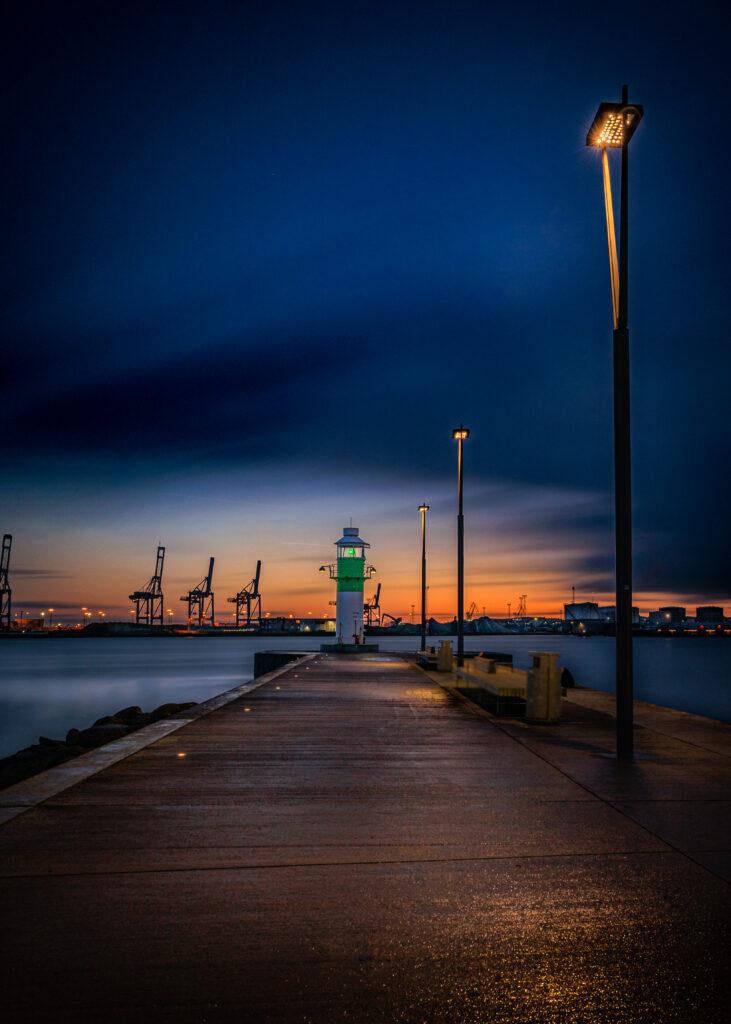
Today, however, the area has become one of the city’s most popular places for walking, swimming, and photography.
The pier at Bassin 7 stretches about 380 metres (1,250 ft) into the harbour and offers excellent photographic opportunities.
Near the entrance to the basin you’ll see a 14-metre observation tower designed by architect Dorte Mandrup and donated to the city by the Salling Foundations. On calm evenings you can capture reflections here with the modern residential complex Nicolinehus in the background.
Turn around and you’ll see the harbour bath designed by the Danish architect Bjarke Ingels. From here you also have views towards Pier 3 and the surrounding harbour landscape.
Personally, my favourite viewpoint is at the end of the pier. From here you can see Lighthouse, Denmark’s tallest residential building, on one side — and a small harbour lighthouse on the other.
The pier is also a popular recreational space, so you’ll often meet anglers, runners and people taking an evening stroll.
The location works beautifully at sunrise and sunset, when the sky often turns deep yellow, orange and red.
4. Godsbanen & Institut for (X) – Creative Light and Raw Urban Culture
The former freight yard area around Godsbanen has become one of Aarhus’ most vibrant cultural districts.

Godsbanen opened as a cultural centre in 2012, and the surrounding area has since filled with workshops, theatres, concert venues, cafés and creative communities.
This makes it a fantastic place for urban night photography
One of the best viewpoints is the sloping roof of the Godsbanen building. When the cultural centre was created, two old freight halls were preserved and a new building was constructed between them. Today the roof functions as a public urban space.
From here you have a great view across the entire area — including a glimpse of the famous rainbow panorama on the ARoS Art Museum.
You can experiment with several photographic techniques here. For example:
reflections in the illuminated roof boxe
long exposures of city lights
shots of Signe Klejs’ light installation on Ringgadebroen
Nearby you’ll also find Institut for (X), a creative area built largely from recycled materials such as shipping containers and construction trailers that have been transformed into studios and workshops.
Under Ringgadebroen you’ll find Volume Village, a venue hosting concerts, events and small festivals in a lively atmosphere of street culture and youth creativity.
And yes — on some evenings the smell of cannabis can be a little noticeable. On the other hand, you can capture some truly striking photos of the bridge from this location.
5. Elviraminde Chocolate Factory – Industrial History in the City Centre
My final recommendation is the former Elviraminde Chocolate Factory, located just a few minutes from the city centre.

The complex can be entered from several sides, but I recommend walking through the gate from Klostergade.
It’s almost hard to imagine that around 500 people worked here in 1925, many of them children, producing large quantities of sweets — including the famous Danish Samba cream puffs.
The factory was built in 1912 and designed by architect Christian Frühstück Nielsen, who later also designed Borgporten, one of the city’s distinctive historic gateways.
Chocolate production stopped here in 1967, and the factory later housed a variety of cultural activities — including a jazz venue and a circus school.
Today the buildings contain architectural studios, cafés, a wine bar, a fitness centre and the art shop Art De Voss.
What makes the place especially fascinating for photography is that the industrial character has been preserved right in the middle of the city.
Personally, I’m drawn to the many staircases and the warm light that shines through the old factory windows in the evening.
Final Thoughts
These are my five favourite night photography locations in Aarhus.
I hope this guide inspires you to explore the city yourself with a camera once darkness falls.
Aarhus may not be the largest city in Europe — but when night comes and the lights appear, it becomes a truly wonderful place for photography.